#agents

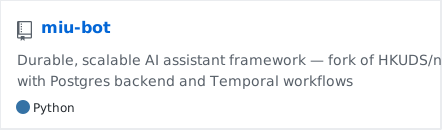
I learned agentic AI concepts in Python - agent loops, tool calling, multi-agent coordination, production patterns. I even built my own Python assistant - MiuBot - with 10 chat channels, Temporal workflows, and multi-tenant workspaces. Python works well for most of these cases. But while building MiuBot, I kept hitting the same question: what happens when you need to serve many users concurrently over WebSocket with streaming responses? That’s when I discovered GoClaw from the NextLevelBuilder team, and it changed how I think about the problem.
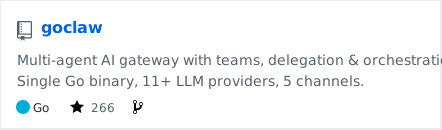
GoClaw

Read More

After months of studying agentic AI patterns in theory - agent loops, tool calling, multi-agent coordination - I wanted to build something real. Not another tutorial project, but an AI assistant I could actually use daily, connected to the chat platforms I already live on. That’s how MiuBot started - forked from Nanobot, then reshaped into something quite different.

MiuBot

Read More

Single agents hit a ceiling. When tasks require diverse expertise - research, coding, analysis, writing - a single agent either becomes overloaded with tools or produces mediocre results across domains. Multi-agent systems solve this by decomposing work among specialized agents, each focused on what it does best.

Read More

Traditional RAG is a one-shot process: retrieve documents, generate answer, done. Agentic RAG breaks this limitation - agents can evaluate retrieval quality, reformulate queries, and iterate until they find what they need. Combined with human-in-the-loop patterns, you build systems that are both autonomous and controllable.

Read More

Agents become truly useful when they can interact with the real world - fetching live data from APIs, querying databases, and writing results back. This post covers building production-grade integrations: API tools with proper error handling, SQL agents that translate natural language to queries, and security patterns that prevent disasters.

Read More

LCEL chains are powerful but limited - they can’t loop, branch dynamically, or maintain complex state between steps. LangGraph solves this by modeling agent workflows as state machines: graphs where nodes are processing steps and edges define control flow. This explicit structure enables cycles, conditional routing, and persistent state that production agents require.

Read More

The LangChain Expression Language (LCEL) transforms how we build LLM workflows. Instead of managing execution flow manually, LCEL lets you compose components declaratively - like Unix pipes for AI. Combined with tool integration, LCEL enables building agents that reason and act in the real world.

Read More

Your browser is out-of-date!

Update your browser to view this website correctly. Update my browser now

×