I learned agentic AI concepts in Python - agent loops, tool calling, multi-agent coordination, production patterns. I even built my own Python assistant - MiuBot - with 10 chat channels, Temporal workflows, and multi-tenant workspaces. Python works well for most of these cases. But while building MiuBot, I kept hitting the same question: what happens when you need to serve many users concurrently over WebSocket with streaming responses? That’s when I discovered GoClaw from the NextLevelBuilder team, and it changed how I think about the problem.
Python Works - Until It Doesn’t
Python’s AI ecosystem is enormous. LangChain, LangGraph, AutoGen, CrewAI, Haystack, LlamaIndex - for learning and prototyping agent patterns, nothing beats it. I used Python throughout my agentic AI series and LangChain/LangGraph series, and I built MiuBot as a fully working assistant with asyncio, Temporal, and 10 chat channels.
But there’s a gap between “agent that works for a few users” and “agent that serves many users concurrently over WebSocket with streaming responses.” I felt this gap while building MiuBot - Python’s asyncio handles personal-scale concurrency fine, but the architecture decisions for true multi-user scale are fundamentally different. That gap is where language choice starts to matter.
Here’s what the benchmarks show for Go vs Python gateways at scale (Bifrost Go proxy vs LiteLLM Python proxy):
| Metric | Go Gateway | Python Gateway | Difference |
|---|---|---|---|
| P99 Latency | 1.68s | 90.72s | 54x lower |
| Throughput | 424 req/s | 44.84 req/s | 9.5x higher |
| Memory | 120MB | 372MB | 3x lower |
| Instances at 10K RPS (extrapolated) | ~24 | ~223 | ~9x fewer |
Python’s GIL means true parallelism requires multiprocessing with its own overhead. Go’s goroutines handle thousands of concurrent WebSocket connections, streaming LLM responses, and parallel tool execution on a single binary. No virtualenv, no dependency hell, no 500MB Docker images - just a ~15MB compiled binary.
Python remains the right choice for ML training, fine-tuning, and rapid prototyping. But for a chat application gateway handling real-time agent interactions at scale, Go is a stronger fit.
GoClaw: An AI Agent Gateway Built in Go
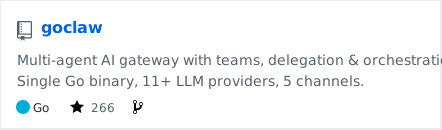
GoClaw is an open-source AI agent gateway built by NextLevelBuilder. It combines WebSocket RPC, HTTP API, multi-channel messaging, and a full agent loop into a single Go binary. What impressed me is how cleanly it implements the same agentic patterns I learned in Python - but designed for production from the start.
Before diving into GoClaw’s design, here’s where it sits in the landscape:
Python frameworks (LangChain, CrewAI, AutoGen) give you building blocks for agent logic. They’re libraries you import and compose in your application code.
OpenClaw (Node.js/TypeScript) is the closest architectural peer. It runs as a single gateway process with WebSocket RPC and multi-channel messaging. It’s personal-use focused: file-based storage, single-user, no multi-tenancy. OpenClaw was one of the inspirations when I built MiuBot in Python.
GoClaw takes this further: a multi-tenant AI agent gateway with PostgreSQL persistence, RBAC, encrypted credential storage, and team-level isolation. Where MiuBot solves similar problems with Python’s asyncio and Temporal, GoClaw solves them natively in Go.
Go-native AI frameworks are emerging too - Google ADK for Go, ByteDance’s Eino, LangChainGo - but they’re SDK libraries, not operational gateways. GoClaw sits one layer above.
flowchart TB
    subgraph Frameworks["SDK / Frameworks"]
        direction LR
        LC["LangChain
Python"]
        AG["AutoGen
Python"]
        EI["Eino
Go"]
    end

    subgraph Gateways["Gateways / Servers"]
        direction LR
        OC["OpenClaw
Node.js
Single-user"]
        GC["GoClaw
Go
Multi-tenant"]
    end

    subgraph Platforms["Platforms"]
        direction LR
        DI["Dify
Python+TS
Visual builder"]
    end

    Frameworks --> |"import as library"| App["Your Application"]
    Gateways --> |"connect via WebSocket/HTTP"| App
    Platforms --> |"no-code UI"| App

    classDef blueClass fill:#4A90E2,stroke:#333,stroke-width:2px,color:#fff
    classDef orangeClass fill:#F39C12,stroke:#333,stroke-width:2px,color:#fff
    classDef greenClass fill:#27AE60,stroke:#333,stroke-width:2px,color:#fff
    class LC,AG,EI blueClass
    class OC,GC orangeClass
    class DI greenClass
The Agent Loop: Same Concept, Different Runtime
The core agent loop I covered in Anatomy of an AI Agent - Perceive → Reason → Plan → Act - maps directly to GoClaw’s implementation. In the LangGraph series, we built this as a state graph. GoClaw implements it as a bounded iteration loop:
1 | func (l *Loop) runLoop(ctx context.Context, req RunRequest) RunResult { |
Same Think→Act→Observe cycle. But GoClaw adds production safeguards that tutorials typically skip.
Loop Detection
What happens when the LLM calls the same tool with the same arguments and gets the same result, repeatedly? In a tutorial, you hit max iterations. In production, you’re burning tokens for nothing.
GoClaw hashes every (tool, args, result) tuple with SHA256. Three identical calls trigger a warning injected as a system message nudging the LLM to try a different approach. Five identical calls force the loop to exit.
stateDiagram-v2
    [*] --> Running
    Running --> ToolCall: LLM requests tool
    ToolCall --> HashCheck: SHA256(tool+args+result)
    HashCheck --> Running: unique hash
    HashCheck --> Warning: 3 identical calls
    Warning --> Running: nudge different approach
    HashCheck --> ForceExit: 5 identical calls
    ForceExit --> [*]
    Running --> [*]: no tool calls (done)
This is a real production problem. No amount of prompt engineering fully prevents it - you need infrastructure-level detection.
Parallel Tool Execution
When the LLM requests multiple tool calls in a single response, GoClaw runs them concurrently with goroutines:
1 | var wg sync.WaitGroup |
In Python, you’d use asyncio.gather() or ThreadPoolExecutor (as covered in Multi-Agent Architecture). In Go, goroutines are the native primitive - no async/await coloring, no event loop to manage.
Context Window: The Three-Layer Defense
From Prototype to Production covered token tracking and cost control at a high level. GoClaw implements context window management as a three-layer pipeline - this is one of the most thoughtful parts of the architecture:
Layer 1 - History Limiting. Keep the last N user turns. Simple but coarse.
Layer 2 - Context Pruning. For old tool results (which tend to be large), apply a two-pass strategy:
- Soft trim: keep first 1500 chars + last 1500 chars, drop the middle
- Hard clear: replace entire result with
[Old tool result content cleared]
Hard clear only activates when context exceeds 50% of the window AND prunable content exceeds 50K characters.
Layer 3 - Auto-Summarization. When history hits 75% of the context window, a background goroutine summarizes older messages via an LLM call, keeping only the last 4 messages intact.
flowchart LR
    A["Raw History"] --> B["Layer 1
Limit Turns"]
    B --> C["Layer 2
Prune Tool Results"]
    C --> D["Layer 3
Auto-Summarize"]
    D --> E["Final Context
< Window Size"]

    classDef blueClass fill:#4A90E2,stroke:#333,stroke-width:2px,color:#fff
    classDef orangeClass fill:#F39C12,stroke:#333,stroke-width:2px,color:#fff
    classDef greenClass fill:#27AE60,stroke:#333,stroke-width:2px,color:#fff
    class A blueClass
    class B,C orangeClass
    class D greenClass
    class E blueClass
A neat detail: the session queue applies adaptive throttle when context usage hits 60% - it serializes requests to prevent two concurrent runs from both triggering summarization simultaneously. This is the kind of concurrency bug that only surfaces under real load.
Tool Policy: Beyond Simple Registration
In Extending Agents with Tools, I learned to register tools as Python functions with schemas. GoClaw shows what tool management looks like in a multi-tenant system where the question isn’t just “what tools exist?” but “who gets access to what?”
Its tool policy engine evaluates access in 7 steps:
- Global profile (minimal/coding/messaging/full)
- Provider-level profile override
- Global allow list
- Provider-level allow override
- Per-agent allow list
- Per-agent per-provider allow
- Group-level allow
Then: global deny → agent deny → alsoAllow (additive union).
Tools are stateless - they implement a Tool interface and receive per-call state through Go’s context.Context:
1 | type Tool interface { |
Optional capability interfaces let tools opt into features without polluting the base interface:
1 | type SandboxAware interface { |
This is Go’s interface composition - small interfaces, opt-in capabilities, checked at registration time. The Python equivalent would be mixins or decorators.
Memory: Hybrid Search in Practice
In Agentic RAG, I explored hybrid search combining BM25 keyword matching with vector similarity. GoClaw implements exactly this with SQLite FTS5 for BM25 and in-memory cosine similarity for vectors:
1 | func (s *Store) HybridSearch(query string, limit int) ([]Chunk, error) { |
The key design choice: graceful degradation. No embedding provider configured? Memory still works with FTS-only search. Vector search fails at runtime? Falls back to FTS. This “always works, sometimes works better” approach is something I wish more Python frameworks adopted.
Concurrency: Lane-Based Scheduling
In Multi-Agent Routing, State, and Coordination, I covered thread-safe shared state and routing patterns. GoClaw’s scheduler is a three-level hierarchy that takes these concepts much further:
1 | Scheduler → LaneManager → SessionQueue |
Lanes are named worker pools using semaphore channels:
| Lane | Concurrency | Purpose |
|---|---|---|
main |
30 | User chat messages |
subagent |
50 | Child agent loops |
delegate |
100 | Agent-to-agent delegation |
cron |
30 | Scheduled tasks |
Session queues add per-session ordering: FIFO with debounce (800ms default to collapse rapid messages), drop policies (drop_old or drop_new), and interrupt mode (cancel current run, start new one).
This solves a problem unique to chat applications: when a user sends 5 messages in 3 seconds to a long-running agent, what happens? GoClaw debounces them, queues them, and processes them in order - or interrupts if configured to do so. This is trivial with Go channels, complex with Python’s asyncio.
Provider Abstraction
In Mastering LangChain, I learned how LangChain abstracts providers behind a common interface. GoClaw follows the same principle with a minimal 4-method interface:
1 | type Provider interface { |
Optional capabilities use separate interfaces - for example, ThinkingCapable gates extended thinking parameters so non-supporting providers never see them. Retry logic uses a generic RetryDo[T]() with exponential backoff, jitter, and Retry-After header respect.
Multi-Channel Delivery
This goes beyond what I covered in the Python series. The blog posts focused on agent logic; GoClaw addresses a different question: how do agents reach users where they are?
Its channel system supports Telegram, Discord, Feishu/Lark, WhatsApp, and Zalo through a common interface with optional streaming and reaction capabilities. When the LLM streams token by token, streaming channels edit the message in real-time. Reaction channels place emoji on the user’s message to show status: thinking, executing tool, done, or error.
A central manager goroutine consumes from an event bus and dispatches to the appropriate channel. Inbound messages from any channel normalize through the same bus.
Two Modes: Standalone and Managed
GoClaw runs in two modes using the same codebase:
Standalone - file-based storage, single workspace, zero configuration beyond an API key. Quick to get started, similar to OpenClaw.
Managed - PostgreSQL with pgvector, per-user isolation, RBAC (admin/operator/viewer), AES-256-GCM encrypted API keys, multi-agent support. This is the team/org deployment.
The store layer uses Go interfaces with two implementations (file/ and pg/). Managed-only stores are simply nil in standalone mode - the code checks and skips managed paths. No feature flags, no mode enums.
Subagents: Controlled Delegation
Designing Multi-Agent Architecture covered bounded responsibility and failure planning. GoClaw enforces these principles structurally:
- Depth limit (default 3) - prevents infinite delegation chains
- Per-parent children limit (8) - bounds fan-out
- Tool deny lists - leaf agents get restricted tool sets (no spawning further subagents)
- Dedicated scheduler lanes - subagents don’t compete with user messages for slots
This is the “specialization” principle from the theory, enforced at the infrastructure level rather than relying on prompt instructions.
What This Teaches
Studying GoClaw’s architecture after building MiuBot in Python reinforced a few things:
The agent loop is the easy part. Think→Act→Observe fits in 50 lines of any language. The hard parts are context window management, concurrent session handling, graceful degradation, and multi-tenant isolation.
Go’s concurrency model is a natural fit for chat gateways. Goroutines for parallel tool execution, channels for event broadcasting, sync.WaitGroup for coordinating results. No colored functions, no async/await split.
Interface composition works beautifully for tool systems. Small interfaces (Tool, SandboxAware, StreamingTool) composed at registration time give you Python’s duck typing with compile-time safety.
Python and Go serve different stages. Python for learning, prototyping, and building personal assistants like MiuBot. Go for serving agents at scale in a concurrent, multi-user chat application. I’m now migrating my setup to GoClaw for the production gateway while keeping Python for experimentation.
Key Takeaways
- Python works well for learning and prototyping agent patterns. The ecosystem is unmatched. But for production chat gateways serving concurrent users, Go’s runtime characteristics are a better fit.
- Go’s goroutines eliminate the async complexity that surfaces when handling many concurrent WebSocket connections with streaming responses.
- Context window management needs multiple layers. History limiting, content pruning, and auto-summarization work together - no single strategy is sufficient.
- Tool access control is a production requirement, not an afterthought. Multi-tenant systems need policy engines, not just registries.
- Loop detection saves real money. A stuck agent burning tokens in a loop is invisible until your bill arrives. Hash-based detection catches it early.
- Graceful degradation beats hard dependencies. Memory works without vectors. Channels work without streaming. Every optional capability has a working fallback.
- The concepts transfer across languages. ReAct loops, hybrid search, multi-agent coordination, provider abstraction - the principles are language-agnostic. GoClaw is proof that what you learn in Python applies directly to Go.
If you’re interested in GoClaw, check out the project on GitHub. For the Python side of this journey, see Building MiuBot and the foundational concepts in my Agentic AI series and LangChain/LangGraph series.
Comments