Most people first meet Claude Code as a chatbot in a terminal. That mental model is too small.
Ask it to explain a bug and it may answer once. Give it a concrete engineering objective and permission to work, and it can read the repository, trace the code, edit files, run tests, inspect the result, and change course when the evidence contradicts its plan. That repeated cycle is what makes the workflow agentic.
This is Part 1 of 6 in my Agentic Coding with Claude Code series. The working model I am keeping is simple: Claude Code is a bounded loop of perceive, reason, act, and feedback, not a longer chatbot reply.
Later posts will cover context, the harness / Agent SDK / stop-reason loop, MCP, evals, and guardrails. This one stays on the loop, the components, and the patterns.
From a Prompt to an Agentic Loop
A single-turn interaction ends after one reply. Agentic coding keeps going until the definition of done has evidence.
flowchart TB
    Obj[Objective] --> Perc[Perceive]
    Perc --> Reas[Reason]
    Reas --> Act[Act]
    Act --> Feed[Feedback]
    Feed -->|more evidence needed| Perc
    Feed -->|definition of done met| Done[Verified result]

    classDef blueClass fill:#4A90E2,stroke:#333,stroke-width:2px,color:#fff
    classDef orangeClass fill:#F39C12,stroke:#333,stroke-width:2px,color:#fff
    classDef greenClass fill:#27AE60,stroke:#333,stroke-width:2px,color:#fff
    classDef purpleClass fill:#9B59B6,stroke:#333,stroke-width:2px,color:#fff
    classDef tealClass fill:#16A085,stroke:#333,stroke-width:2px,color:#fff
    classDef redClass fill:#E74C3C,stroke:#333,stroke-width:2px,color:#fff

    class Obj blueClass
    class Perc orangeClass
    class Reas greenClass
    class Act purpleClass
    class Feed tealClass
    class Done redClass
The difference is not that the model produces a longer answer. The difference is that it can take multiple grounded actions, receive feedback from the environment, and adapt until it reaches a defined outcome.
Official How Claude Code works names the same cycle in product language: gather context, take action, verify results. I am keeping the four names I already use: perceive, reason, act, feedback.
Autonomy is still bounded. Claude Code operates with the context, tools, permissions, and constraints that I give it. A useful agent is not one that acts without limits. It is one that can make progress independently while keeping its work inspectable and stopping at the right boundaries.
The Perception-Reasoning-Action Loop
The engine of an agentic system is a continuous feedback loop.
1. Perception: Build a Current View of the Work
The agent gathers the information needed to understand the task and its environment. In Claude Code, perception can include:
- The request and definition of done
- Repository instructions in
CLAUDE.md, including any imported guidance - Source code, configuration, documentation, and git state
- Test failures, logs, API responses, and runtime output
- Results returned by tools used in an earlier step
This is why a strong coding agent reads before it edits. A bug report describes a symptom. The repository and runtime evidence reveal the actual system.
2. Reasoning: Choose the Next Useful Step
Claude analyzes what it has observed, forms a working model of the problem, and decides what to do next. That may mean decomposing a large objective, tracing callers, comparing implementation options, or recognizing that more evidence is needed before changing code.
For collaboration, the useful outputs are a concise plan, stated assumptions, decisions, and evidence. I do not need a transcript of hidden reasoning. I need enough visibility to understand what the agent is doing and to redirect it when necessary.
3. Action: Change or Query the Environment
Claude Code acts through tools. It can search and read files, apply edits, run commands, execute tests, inspect git history, call connected services, or delegate a bounded task to a specialized agent.
A tool call is not progress by itself. Its result must move the objective forward or improve the agent’s understanding of the problem.
4. Feedback: Turn Results into the Next Perception
Every action produces evidence: a diff, a passing test, a compiler error, a changed API response, or a new failure. That evidence becomes the next perception.
If the test fails, the agent revises its model. If the test passes but the diff touches unrelated files, it tightens the change. If the local result is correct but the user asked for runtime proof, it continues to the authorized verification boundary.
The takeaway I kept: the loop ends when the definition of done is supported by evidence, not when the agent has merely produced code.
A Sketchnote of the System
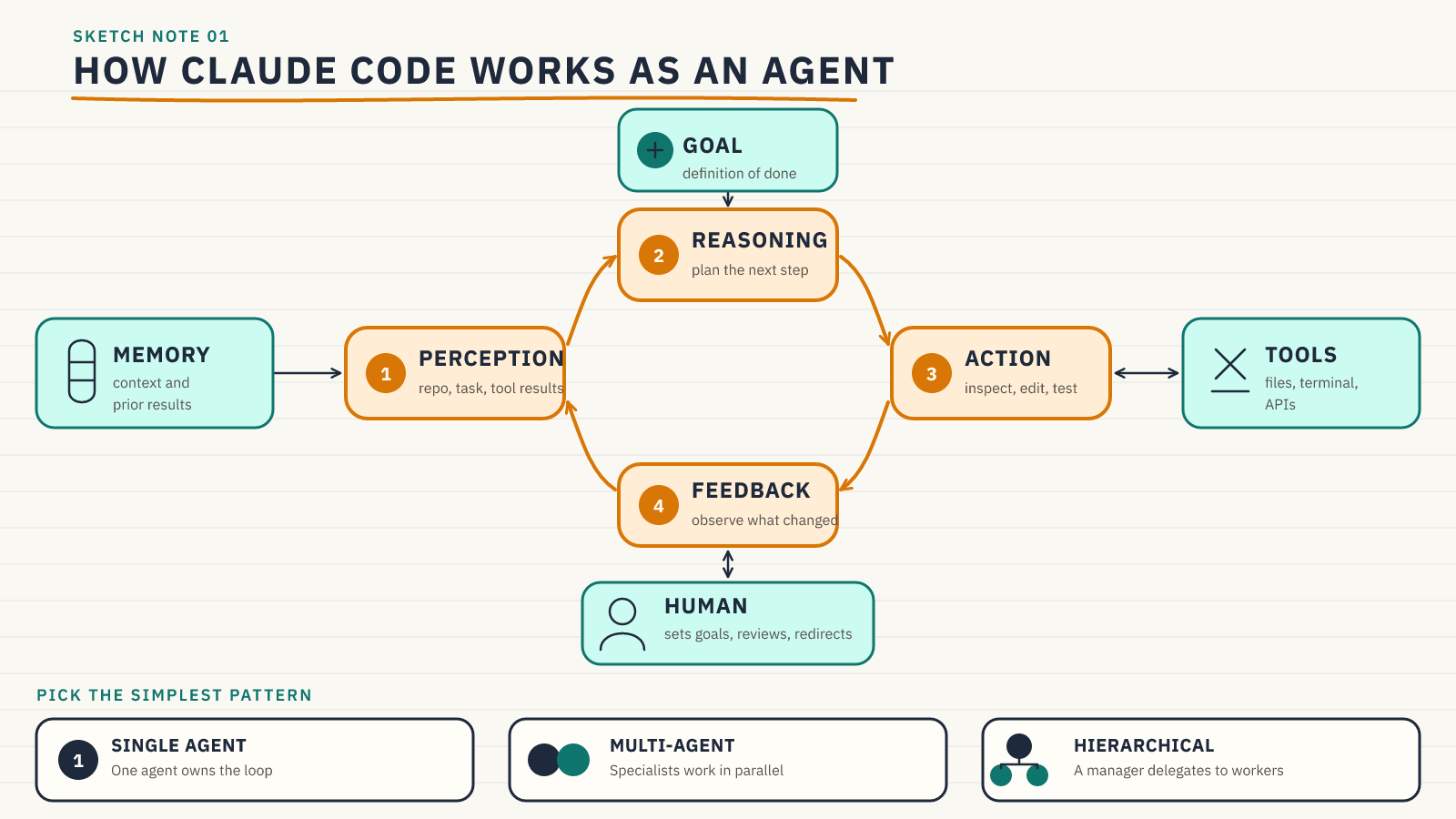
The central loop is only one part of the system. Goals, tools, memory, the reasoning engine, and the human collaborator determine whether that loop is useful and safe.
The Core Components
| Component | In a Claude Code workflow | Question to answer |
|---|---|---|
| Goal | The requested outcome and definition of done | What evidence will prove the work is complete? |
| Tools | File access, shell commands, tests, git, browsers, APIs, and MCP servers | What can the agent observe or change? |
| Memory | Current context, repository instructions, prior tool results, and durable project knowledge | What must remain available for the next decision? |
| Reasoning engine | The Claude model that interprets context and selects the next action | Is the model receiving the right evidence and constraints? |
| Human collaborator | The person who sets goals, supplies judgment, reviews evidence, and approves risky boundaries | When should the agent proceed, report, or stop for approval? |
Goal: Define Success Before Activity
“Fix the login bug” is a direction. A stronger goal defines the observable result:
1 | Fix the login regression at its shared root cause. |
The clearer the finish line, the less likely the agent is to optimize for visible activity instead of the actual outcome.
Tools: Capabilities with Boundaries
Tools turn a language model into a working agent. File tools let Claude inspect and edit the repository. The terminal lets it compile and test. APIs and MCP servers connect it to external systems.
Every tool also expands the failure surface. Read access is different from write access. Editing a local file is different from merging a pull request or changing production. Give the agent the smallest authority that still allows it to complete the task, and make approval boundaries explicit.
Memory: Preserve Context, Verify Reality
An agent needs memory to connect one step to the next. For coding work, memory usually exists at three levels:
- Working context: the current request, open files, recent commands, and tool results
- Project context: repository rules, architecture documents, conventions, and accepted patterns
- Durable context: knowledge carried across sessions, such as prior decisions or recurring workflows
Memory helps continuity, but it can become stale. Current source code, live runtime state, and fresh test output remain the authority.
Reasoning Engine: Claude Is the Brain, Context Shapes the Decision
The Claude model interprets the goal and observations, then chooses the next action. Its effectiveness depends on more than model capability. Missing files, vague tool descriptions, noisy context, or an ambiguous definition of done can all lead to poor decisions.
Good agentic coding is therefore also context engineering: give the model the right instructions, relevant evidence, and clear tool contracts while keeping irrelevant material out of the working set.
Human Collaborator: Control the Objective and the Boundaries
The human is part of the system, not an exception to it. I contribute product intent, architectural judgment, risk tolerance, and authority that the agent should not invent.
A practical collaboration loop looks like this:
- Before work: define the goal, scope, constraints, and proof required
- During work: review decisions, assumptions, diffs, and evidence
- At risky boundaries: approve external, destructive, or production actions
- At completion: verify the final artifact or runtime outcome
Choosing an Agentic Design Pattern
More agents do not automatically produce better work. Start with the simplest structure that can complete the objective.
flowchart TB
    subgraph Single["Single agent"]
        direction LR
        S1[Perceive] --> S2[Reason] --> S3[Act] --> S4[Verify]
    end

    subgraph Multi["Multi-agent / hierarchical"]
        direction LR
        M1[Manager] --> M2[Specialist A]
        M1 --> M3[Specialist B]
        M2 --> M4[Integrate]
        M3 --> M4
    end

    classDef greenClass fill:#27AE60,stroke:#333,stroke-width:2px,color:#fff
    classDef orangeClass fill:#F39C12,stroke:#333,stroke-width:2px,color:#fff
    classDef purpleClass fill:#9B59B6,stroke:#333,stroke-width:2px,color:#fff
    classDef tealClass fill:#16A085,stroke:#333,stroke-width:2px,color:#fff

    class S1,S2,S3,S4 greenClass
    class M1 orangeClass
    class M2,M3 purpleClass
    class M4 tealClass
Single agent on the right is the default. Multi-agent on the left is the coordination I add only when the work has real, separable boundaries.
Single-Agent Pattern
One agent owns the task from perception through verification. This is the default for most focused engineering work: fixing a bug, adding a small feature, updating documentation, or investigating a failing test.
Use it when the work shares one context and the steps depend heavily on one another. It minimizes coordination overhead and keeps accountability clear.
Multi-Agent Pattern
Several specialized agents handle independent parts of the objective. One might inspect the backend while another audits the frontend or reviews test coverage.
Use this pattern when tasks can run in parallel, require genuinely different expertise, and have clear ownership boundaries. Avoid it when every agent needs the same evolving context or when their edits would collide.
Hierarchical Pattern
A manager agent decomposes a large goal, delegates bounded sub-tasks, integrates the results, and verifies the whole system.
This fits migrations, cross-layer features, or broad reviews where central coordination matters. It also adds the most orchestration risk: incomplete handoffs, duplicated work, conflicting changes, and a manager that reports progress without proving integration.
The takeaway I kept: start with one agent and add coordination only when the work has real, separable boundaries.
From a Manual Process to a Multi-Agent Workflow
Designing a complete multi-agent architecture turns theory into explicit engineering choices. The goal, agent responsibilities, tools, handoffs, failure handling, and verification path all need to be documented. A resilient design is not a collection of agent names. It is a system in which every agent has a clear job and the whole workflow still produces a verifiable result.
This lens can transform a slow manual process into an intelligent workflow. Specialization lets each agent focus on one responsibility, while parallel execution reduces time when tasks are genuinely independent. The result can be faster and easier to scale than a single-agent sequence, but only when the coordination cost is lower than the time it saves.
Putting the Concepts into Practice
Choose a real task from your backlog and describe it with this compact brief:
1 | Goal: |
Then map the loop:
- What should Claude Code inspect before changing anything?
- What evidence would distinguish the root cause from the symptom?
- Which tools can move the task forward?
- What results should feed the next decision?
- Which actions require human approval?
- Can one agent own the full context, or are there truly independent sub-tasks?
For example:
1 | Find and fix the root cause of the failing checkout flow. |
That prompt does not prescribe every implementation step. It gives the agent a goal, a method for grounding its decisions, a verification standard, and clear authority boundaries.
Multi-Agent Design Exercise
Pick a repetitive, multi-step process from your work. Compiling a weekly report, onboarding a team member, triaging customer issues, or preparing a release are all useful candidates. Sketch the process before deciding how many agents it needs.
Ask:
- Who are the specialized agents?
- What single responsibility does each agent own?
- Which tasks can run in parallel without sharing changing state?
- What information must pass between agents?
- Who integrates the results and verifies the final outcome?
- Where must a human review, approve, or redirect the workflow?
This exercise builds the habit of seeing work as responsibilities, dependencies, and evidence. That is the foundation for designing sophisticated agentic systems without adding agents merely for appearance.
Key Terms
- Agentic coding: Using an AI system that can observe, reason, act through tools, and adapt across multiple steps to complete an engineering objective
- Agent architecture: The blueprint for the agents, responsibilities, tools, communication paths, and controls that solve a multi-step problem
- Agentic system: A goal-directed system that can work across multiple steps, use tools, observe results, and adapt its actions
- Agentic workflow: A predefined orchestration of model, tool, and human steps that completes a multi-step task
- Perception-Reasoning-Action loop: The repeating cycle in which an agent gathers evidence, decides what to do, acts, and uses the result as new evidence
- Goal: The objective and observable definition of success
- Tools: Capabilities that let the agent inspect or change its environment
- Memory: Context retained across steps or sessions to inform future decisions
- Reasoning engine: The model that interprets context and selects the next action
- Single-agent pattern: One agent owns the complete task loop
- Multi-agent pattern: Specialized agents collaborate on separate parts of a goal
- Hierarchical pattern: A manager agent delegates to and coordinates worker agents
Final Thoughts
Claude Code becomes most useful when I stop treating it as an answer generator and start designing the work around a controlled feedback loop. I give it a concrete goal, the right tools, reliable context, and explicit boundaries. Then I judge the result by the evidence it produces. Learning to identify specialized responsibilities and orchestrate them into one verified workflow is a foundational skill for building more capable AI systems.
The rest of the series keeps this loop and asks what occupies the window, what the harness decides, what MCP is allowed to add, how I score a run, and what the agent is allowed to do even when the model wants another hop.
The next post moves from this loop to context engineering: how repository instructions, scoped rules, skills, and tool descriptions shape every decision the agent makes.
References
- AI Engineering with Claude
- How Claude Code works
- Overview
- CLAUDE.md and memory
- Tools reference
- Subagents
- Common workflows
- Best practices
This is Part 1 of 6 in the Agentic Coding with Claude Code series. Next: Part 2, Part 3, Part 4, Part 5, Part 6.
Comments